

A TALE AS OLD AS TIME
It’s a tale as old as time for any product manager. Should we ship a product whose concept is so far ahead of its time, only to inevitably stumble without the necessary technology built in? Or should we persist with technical innovations, blindly for the sake of numbers?
Where should we draw the line?
To find the answer, we would have to go back to where we started and ask why we are doing this again — our users. What do makers and power users today actually want from a 3D printer? The answer to this question will determine a lot, if not everything.
All things considered, the goal is simple: higher-speed, zero-waste multicolor and multi-material printing. That would mean unlocking entirely new possibilities for creativity.
Where should we start?
THE FASTER, THE BETTER
Starting with print time. For a single-nozzle printer, printing in multicolor is a nightmare — you are constantly loading, reloading, and purging, which leaves you with tons of purged waste. Purging also means you are always at risk of color bleeding, which might ruin a print.
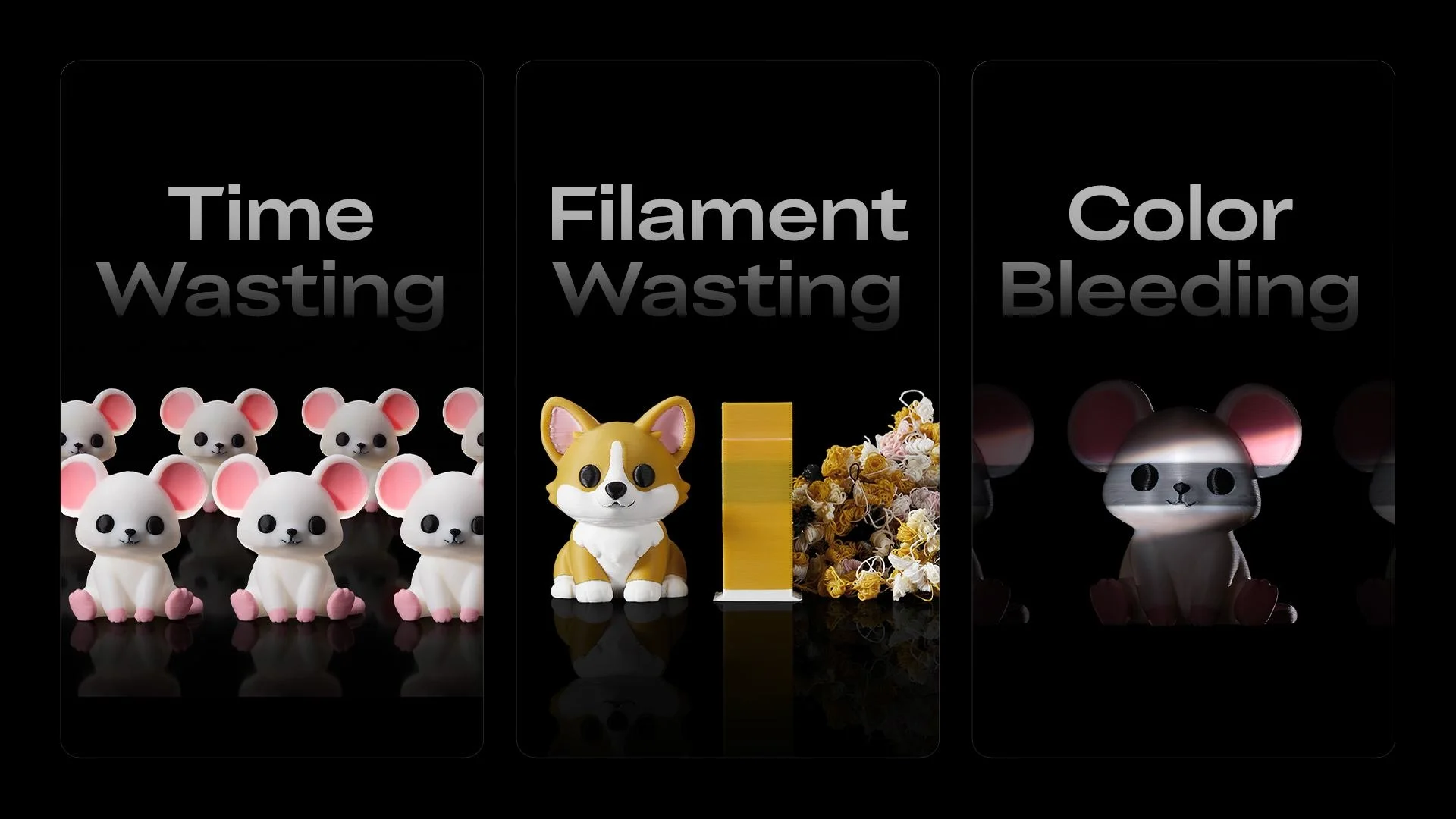
Single-Nozzle or Multi-Nozzle?
The industry introduced dual-nozzle setups — one nozzle for printing the model and another for the support. It’s great for creating easy-to-remove supports and cleaner surfaces. But for more complex 3D models or ones that demand more colors, it seems inadequate.
So, here comes nozzle changing.
Less Is More
Swapping out half a toolhead takes about the same time as changing a nozzle, but it’s much harder to calibrate, as the changed part becomes bulkier.
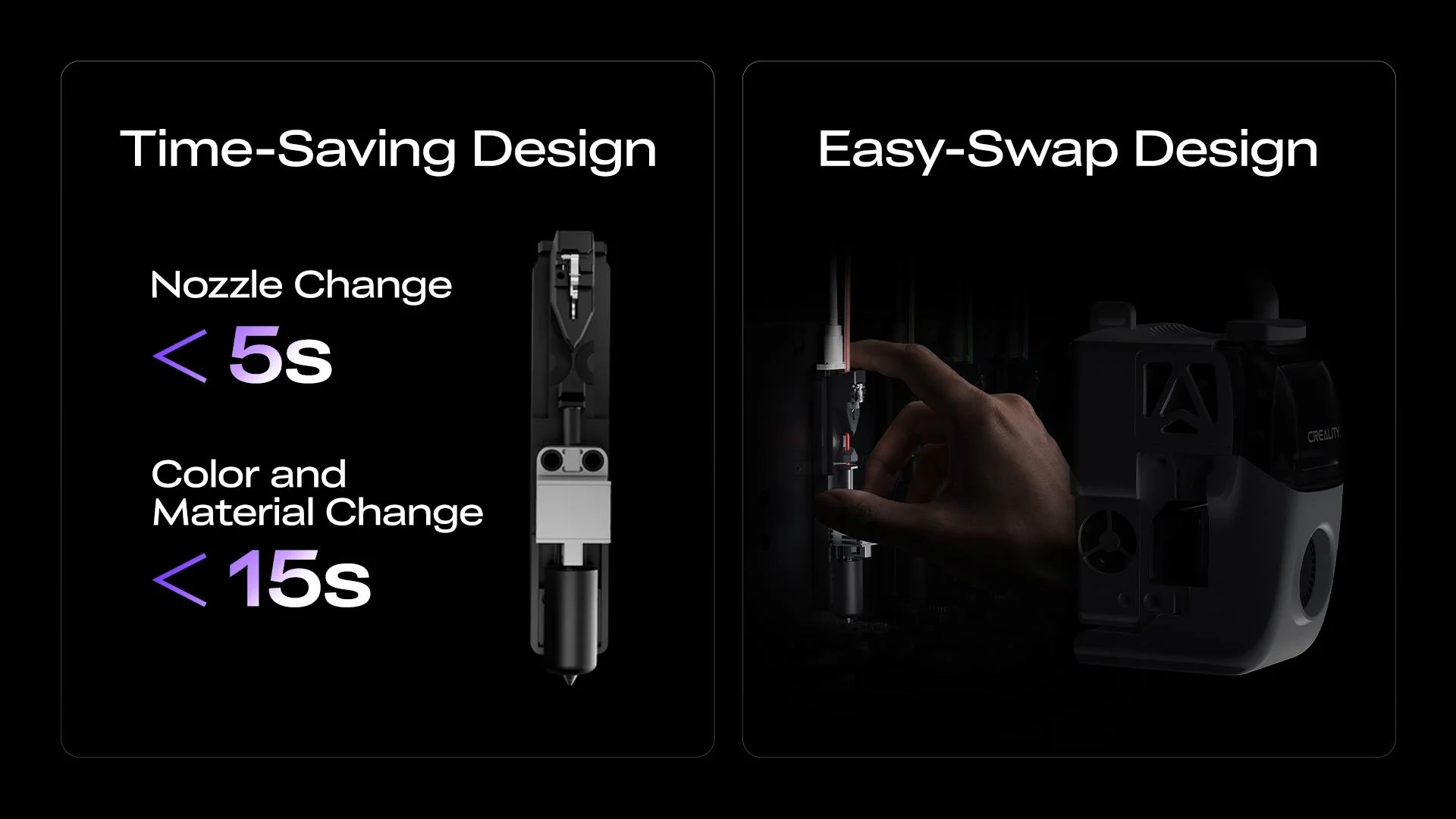
We decided to keep the changing part minimal, only including it where completely necessary — like the hotend, which could enable pre-heating before switching to improve overall efficiency.
The result is that we are changing a part that is highly modular and easily replaceable, with a filament path that is visible for troubleshooting. This could help bring more value to our users over the long term.
The modularity we achieved hit a sweet spot — the nozzle assembly weighs just one-fifth of the weight of the full toolhead. It’s a 5-second nozzle change.
Now that we’ve built an architecture this light, precise, and efficient — what more can we do?
FLEX THE HARDCORE TECH
There is power in a nozzle changer that could bring multicolor and multi-material printing to everyone.
The TPU Problem
Printing TPU is tricky — it’s hygroscopic, meaning moisture affects its properties, so it’s best to dry it before printing. The flexibility and elasticity that make TPU special also make it a nightmare to print; it often requires a specialized feeding tube, a particular feeding angle, or complex workarounds. Friction and deformation cause extrusion failure, and poor retraction control leads to stringing.
Faced with these constant challenges, most printers have to crawl at snail-like speeds for TPU, and even then, they are limited to harder TPU 95A filament. Combining different colors and Shore hardnesses in a single print is pure science fiction.
Rethinking the Extruder
What should we do? Traditional Bowden setups are out of the question, and even standard direct drive units struggle. We tried a lot — softer springs to avoid squeezing the filament, tighter tolerances in the filament tube to prevent the filament from moving too much, and even a custom-shaped filament guide for TPU. But these didn’t solve our problem.
Then came the breakthrough: What if the extruder wasn't just pulling the filament, but was assisted by a secondary extruder unit at the rear pushing it — a dual-power system?
By synchronizing these two forces, the TPU no longer behaves unpredictably. It moves through the tube like a caterpillar. This allows for stable, consistent extrusion of TPU as soft as 80A Shore hardness.
By solving the most challenging problem of TPU extrusion, our system-wide innovations unlock a massive leap in printing speed. While most systems struggle with TPU 80A or 85A — or are forced to slow down to 1 mm³/s — this dual-drive mechanism triples that industry benchmark with a stable 3 mm³/s flow. The advantage is even more pronounced with TPU 95A: KliTek™ achieves a flow rate of 15 mm³/s, 7x that of most consumer 3D printers, which stall at 2–3 mm³/s.
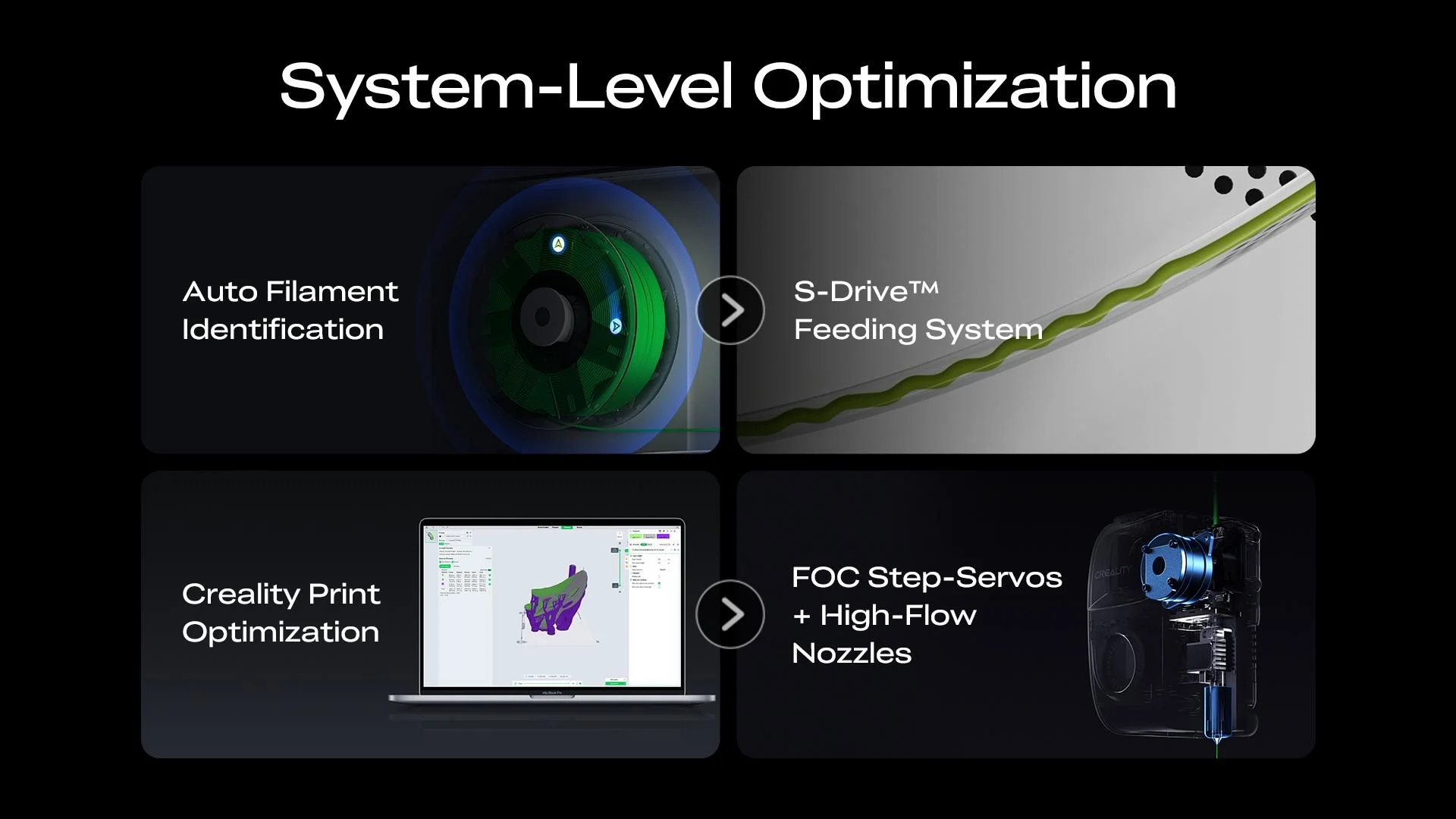
The benefits don't stop at flexibles. This increased flow efficiency boosts PLA performance as well. It’s a patent-pending S-Drive™ feed system.
Best of Both Worlds
What else is possible? Why choose between speed and precision when you can have both?
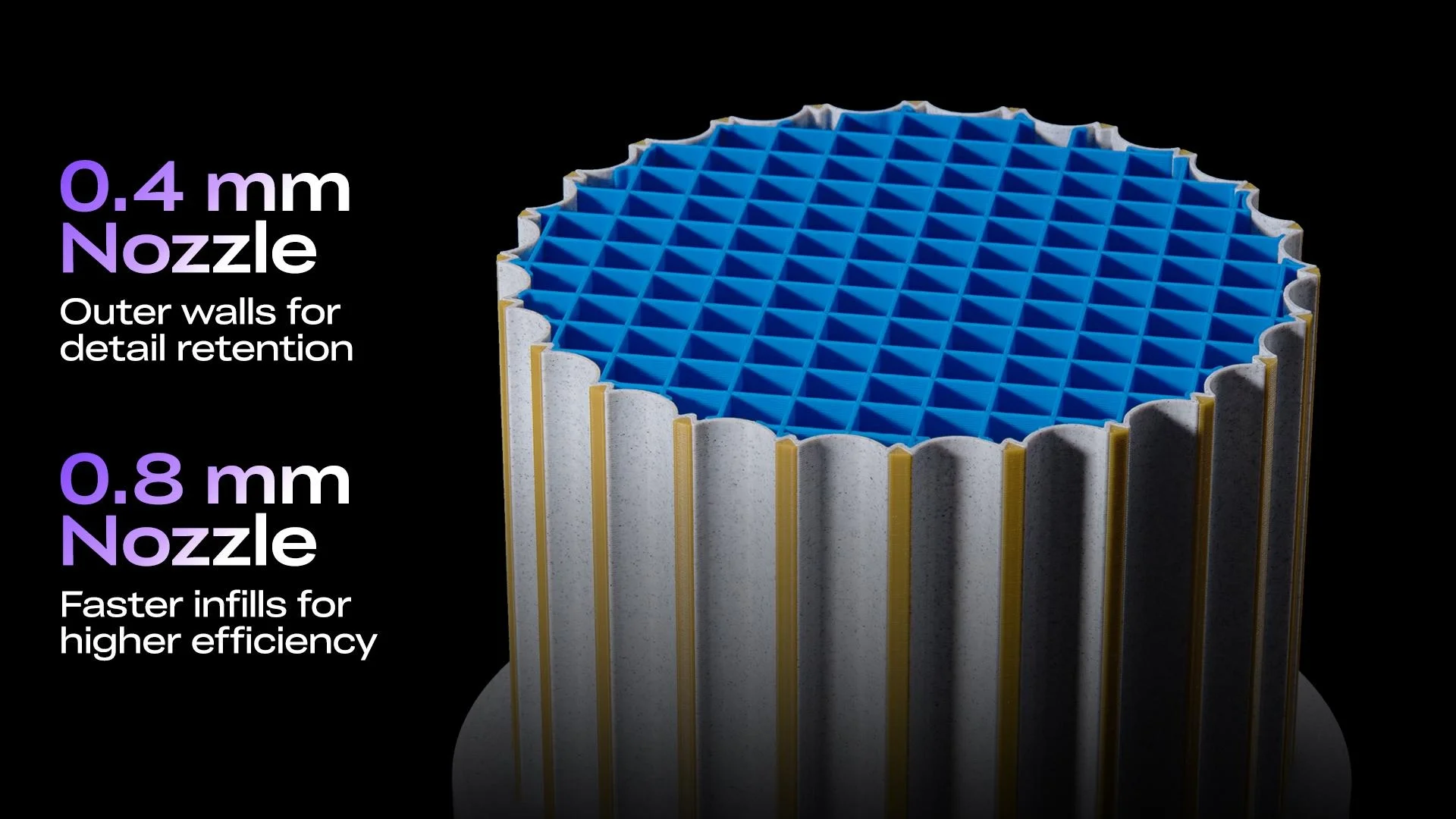
Conventionally, a standard print is limited to a single nozzle diameter. But with a multi-nozzle architecture, we’ve unlocked a new workflow: mixing nozzle sizes within a single print.
Imagine printing the outer walls with a precise 0.4 mm nozzle for max detail retention, while the infill is blasted out by a high-flow 0.8 mm nozzle. We’ve already accelerated multicolor and multi-material printing with nozzle changing; now, this takes efficiency a step further.
The efficiency gains are even more pronounced for larger models.
Speed isn't the point — getting the model done faster is. Multicolor isn't the point — it’s about one-and-done vibrancy. Multi-material itself isn't the point — it’s always about possibilities, like merging the rigid with the flexible.
This is KliTek™, a lightweight nozzle-changing system with no compromise between speed and precision. It enables stable printing of 80A TPU and delivers a breakthrough — print-in-place production of multicolor and multi-material prints.
Should we build the tool first and then find a use for it, or vice versa? It’s a distinction without a difference now.
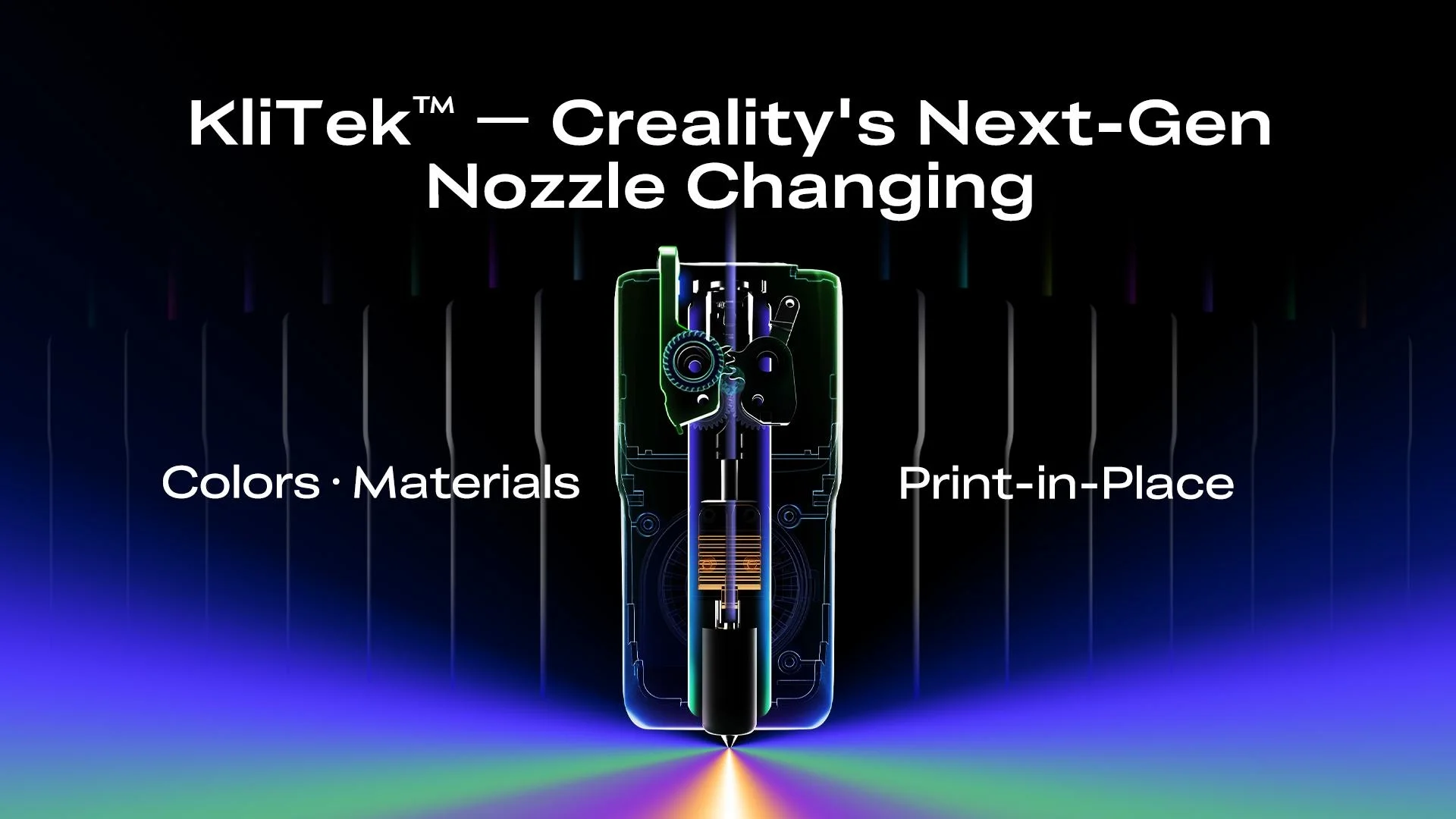
Meet KliTek™ — Creality's next-gen nozzle changer: https://www.creality.com/campaigns/creality-nozzle-changing-3d-printer-2026